
B2B Marketing for Manufacturers: A Practical Guide to Building a Predictable Pipeline
Most manufacturing marketing advice reads like it was written for a software company and relabeled for an industrial one.
Most manufacturing marketing advice reads like it was written for a software company and relabeled for an industrial one. It talks about personas and funnels and skips the part that matters: an engineer, a procurement manager, and a plant owner evaluate a supplier differently, and your website and search presence have to handle all three at once.
This guide is designed for manufacturers with lean marketing teams, complex products, technical buyers, and sales processes built around RFQs, quote requests, demos, or direct sales conversations.
It covers what makes manufacturing marketing different, how to build a website that produces RFQs instead of just describing your capabilities, where SEO and paid search fit, how content should map to the buying process, how to connect marketing to sales, and what order to build all of it in. For the wider picture across channels like email and CRM, see our article, Digital marketing for manufacturers. This one goes deeper into the buying committee, the website, and the sequence for building the whole system.
Skip to the section that matches your gap. The goal is to fix what’s missing, not to read start to finish.
What makes B2B marketing different for manufacturers?
Manufacturing marketing is different because the purchase usually involves several technical stakeholders, a long sales cycle, and a process built around quotes and specifications rather than a checkout button. A generic B2B marketing plan built around one buyer persona and a LinkedIn content calendar misses most of what drives an RFQ.
A few things set manufacturing apart from typical B2B marketing.
The products are technical. A pump, a heat exchanger, or a CNC-machined bracket has tolerances, materials, and performance specs a buyer needs to verify before they’ll even request a quote. Marketing copy about “innovative solutions” doesn’t answer any of that.
The decision involves multiple people. An engineer might specify the part, procurement might negotiate price and terms, and a plant manager might sign off on switching from an incumbent supplier. Each of them wants different information, and none of them is a single buyer persona.
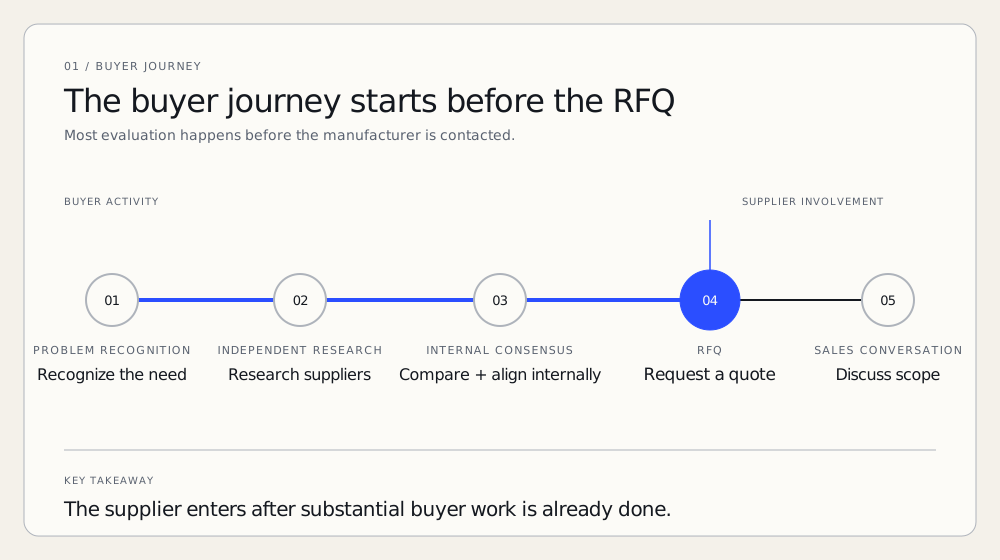
The sales cycle is long, and most of it happens without you in the room. Earlier Gartner research on B2B buying found that buyers spent only about 17% of their total purchase time meeting with potential suppliers. When comparing several vendors, that time was divided across suppliers, leaving roughly 5% to 6% with any one supplier. The broader point still matters: much of the buying process happens through independent research, comparison, and internal consensus-building (Gartner, “How B2B Sales Reps Maximize Customer Interactions,” 2018). If your website and content can’t carry that weight, the decision gets made without your input.
RFQs and tenders replace a simple purchase. There’s often no buy-now button. The conversion event is a quote request, a technical consultation, or a distributor inquiry, and each of those requires more trust than an ecommerce checkout does.
Distributors, reps, and existing relationships still matter. A lot of manufacturing revenue comes through channel partners and long-standing accounts. Marketing has to support that structure instead of assuming every sale starts with a Google search.
Marketing teams are small or nonexistent. Many companies in this position don’t have a dedicated marketing department. Technical knowledge lives with the engineers and the people who’ve been building the product for years, and it rarely makes it into marketing content.
Put these together and the conclusion is simple. Manufacturing marketing isn’t B2B marketing with LinkedIn bolted on. It’s a system built around technical buyers, long evaluation periods, and a quote-based sales process.
What do you need to decide before you choose marketing channels?
Before picking channels, decide what you want marketing to produce. Revenue, RFQs, demo requests, and distributor inquiries are all different outcomes, and the right channel mix depends on which one you’re chasing.
Many manufacturers skip this step and go straight to “we should be on LinkedIn” or “we need better SEO.” That’s picking a channel before deciding what it needs to do.
Work through these questions first.
What should marketing produce? A qualified RFQ is different from a demo request, which is different from a distributor lead. Pick the outcome your sales team can act on.
Which products or applications are worth the marketing spend? Not every product line has the same margin or growth potential. A company making both commodity fasteners and custom precision components should market them differently, if it markets the commodity line at all.
Which markets and industries are you targeting? Food and beverage, aerospace, and general industrial buyers search differently and care about different certifications. Trying to speak to all of them at once usually means speaking clearly to none of them.
What’s your positioning? Buyers want to know what you make, who it’s for, what applications you serve, and why they should consider you over another supplier. Claims like “quality,” “innovation,” or “excellent service” don’t say anything on their own. State what they mean in practice, such as the tolerance you hold, the lead time you guarantee, or the certification you carry that a competitor doesn’t.
What’s your sales capacity? If one person handles all inbound RFQs, tripling the lead volume doesn’t help. It creates a bottleneck and a worse experience for the buyers you do manage to reach.
What’s your average deal value and sales cycle? These determine how much you can spend to acquire a customer and how long you’ll wait to see it pay off. A $2,000 replacement part and a $200,000 custom production line justify very different marketing budgets.
Where do your customers come from today? Referrals, trade shows, an existing distributor network, and outbound sales calls are all valid sources. Marketing should reinforce what’s already working, not replace it by default.
Digital marketing doesn’t have to replace trade shows or your existing sales activity. A common path looks like this: a buyer meets your team at a trade show, goes home, and researches your company online before requesting a quote. If your website and content can back up that research with real specifications and case studies, the trade-show conversation carries through to an RFQ instead of losing momentum.
Answering these turns into a simple chain: market, then ICP, then offer, then buyer, then the problem they’re trying to solve, then the channel that reaches them, then the conversion path, then the sales process that closes them. Channels come after the first five decisions, not before.
Who sits on a manufacturing buying committee?
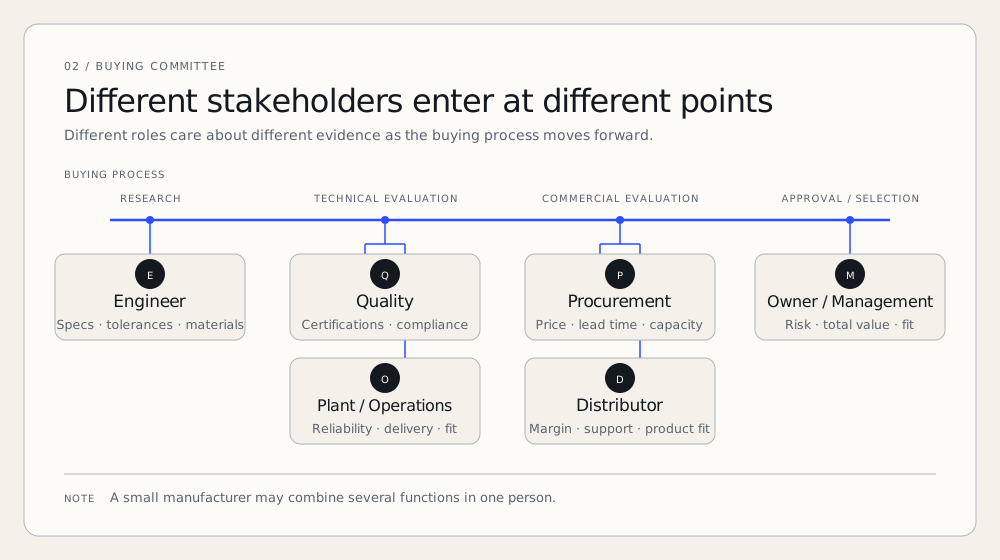
A manufacturing purchase usually involves more than one person, and each one searches and evaluates differently. Treating them as a single buyer persona is why a lot of manufacturing content answers no one’s actual question.
Not every company has every role below. A small shop might have one person doing procurement, engineering review, and final sign-off. A larger buyer might split those across four departments. Either way, the underlying needs don’t change, only who holds them.
| Role | What they care about | What they might search | Content that helps |
|---|---|---|---|
| Design or mechanical engineer | Specs, tolerances, materials, compatibility, standards | Specific standard numbers, material grades, part numbers | Datasheets, spec pages, technical drawings, CAD downloads |
| Procurement or purchasing manager | Supplier capability, pricing, lead times, certifications, capacity | Terms like “manufacturer lead time” or “certified supplier” for the category | Capability pages, certifications, lead-time information, clear RFQ paths |
| Plant or operations manager | Reliability, delivery, downtime, fit with existing equipment | Application-specific terms, problem-focused searches | Application pages, case studies, reliability data |
| Quality manager | Certifications, compliance documentation, traceability | Standard and certification names paired with the product category | Certification pages, quality documentation, compliance FAQs |
| Owner or management | Risk, supplier reliability, total commercial value, long-term fit | Company and category reputation searches | About and company pages, case studies, testimonials |
| Distributor | Margin, support, marketing co-op, fit with existing product lines | Distributor or dealer program terms | Partner program pages, clear terms and contact paths |
The practical takeaway is that your website needs more than one entry point. An engineer landing on a page written for a purchasing manager may struggle to find what they need, and the reverse is just as true.
Can your website generate RFQs, or is it just a brochure?
A manufacturing website should do more than describe your capabilities. It should give each type of buyer enough information to move toward a quote request without needing a phone call first.
Many manufacturing sites fail at this for the same reason. They were built to establish credibility, not to convert a specific visitor into a specific action. That’s a reasonable starting point, but it stalls growth once real traffic starts arriving.
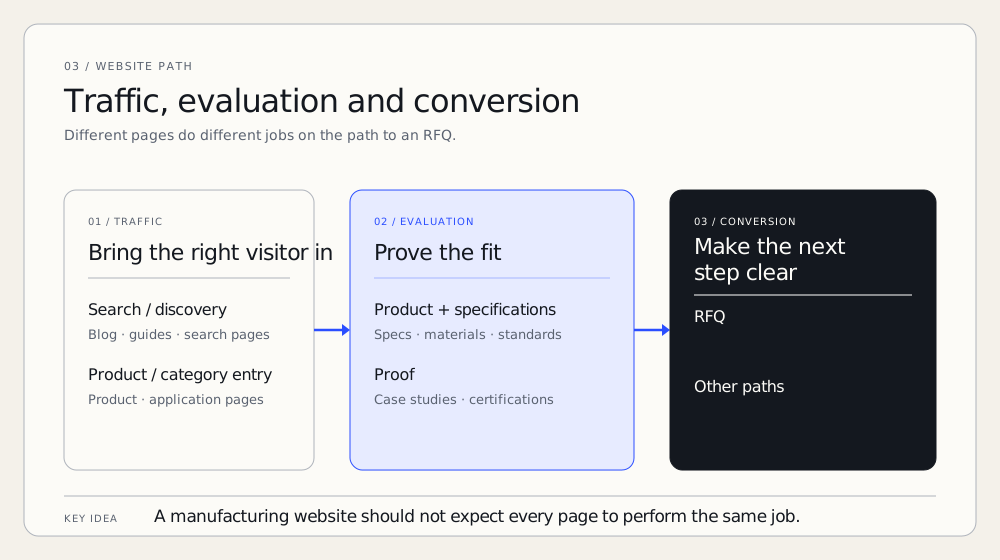
Think of your pages in three categories.
A traffic page is what brings someone to your site in the first place: a blog post, an application guide, or a page ranking for a specific search term.
An evaluation page is where they decide whether you’re a credible option: a product page with real specs, a case study, a certifications page.
A conversion page is where they take the next step: an RFQ form, a contact page, a distributor inquiry page.
Many manufacturing sites have traffic and evaluation pages but only one generic contact form buried in the navigation. That gap is usually the single highest-impact fix on the whole site.
Here’s what a website built to generate RFQs typically needs.
Clear positioning on the homepage. A visitor should understand what you make, who you make it for, and why they’d choose you within a few seconds, not after scrolling through a mission statement.
A product and category structure that matches how buyers think, not how your internal catalog is organized. If engineers search by material and application, and your navigation runs on internal SKU codes, you’re making them do the translation work.
Product pages with actual specifications, not just a photo and a paragraph of marketing copy. Materials, tolerances, standards, and, where relevant, CAD files or technical drawings.
Application and industry pages that speak to a specific use case. “Pumps for food and beverage processing” answers a more specific question than a generic pumps category page.
A manufacturing capabilities page. This matters more for contract manufacturers and custom fabricators than for companies selling a fixed catalog, but it’s often the page procurement checks first.
Case studies that show a real problem and a real result, without inventing numbers you don’t have. Even one or two solid examples do more work than a page of vague claims.
Multiple, obvious paths to request a quote. Not one contact form at the bottom of the site. An RFQ path on product pages, application pages, and anywhere a buyer might be ready to act.
Basic trust signals: certifications, years in business, locations, and a phone number that isn’t hidden three clicks deep.
Reasonable page speed and mobile usability. A slow, hard-to-navigate site loses buyers who never tell you why they left.
For the specific information buyers need before they’ll submit a request, see RFQ checklist for manufacturers.
Where does SEO fit into manufacturing marketing?
SEO matters for manufacturers because it captures demand that already exists. Someone searching for a specific part, material, or application is telling you exactly what they need. The job of SEO is making sure your page is the one that answers that search.
Manufacturing search behavior happens in layers, and keyword research often stops at the first one.
| Search layer | Example query | Best page to answer it |
|---|---|---|
| Product | “1/4 inch stainless steel hex bolt” | Product page |
| Product variant | “flanged vs. threaded ball valve” | Comparison or product page |
| Application | “valve for high-pressure steam line” | Application page |
| Industry | “pumps for food and beverage processing” | Industry page |
| Problem or solution | “how to stop pump cavitation” | Technical guide |
| Material | “PTFE vs. EPDM gasket material” | Material comparison page |
| Standard or spec | “ASME B16.5 flange supplier” | Spec or standards page |
| Part number | A specific manufacturer part number | Product or part page |
| Location | “CNC machining shop Ohio” | Location page |
| Category comparison | “in-house vs. outsourced machining” | Comparison or service page |
The most common mistake is building keyword research around what the company calls its products internally instead of how buyers actually search. An internal part code means nothing to a search engine, or to a new buyer who doesn’t yet know your naming convention.
Manufacturing SEO also runs into problems that don’t show up in a typical B2B SEO guide.
Large product catalogs create thousands of thin pages when every variant gets its own near-identical page with no unique content. Product families and shared specification tables help, but they need to be built with intent, not generated on autopilot.
Technical terminology means the same product might get searched under an industry name, a generic name, and a standard number, all in the same month. Covering the language buyers actually use matters more than covering the language your engineering team uses internally.
International markets complicate things further once you sell in multiple countries, since standards, terminology, and even units of measurement change. We’ve covered that in International SEO for manufacturers.
Search visibility increasingly includes AI-generated answers alongside traditional rankings. The same fundamentals still apply: clear specifications, real technical detail, and pages that answer the question asked.
A full audit of where your site stands today is the starting point for SEO Audit and the Foundational Sprint work, and it’s also where the AEO / AI Search Sprint picks up.
What content helps a buyer evaluate you?
Useful manufacturing content maps to what a buyer needs to know at each stage of their decision, not to a generic list of blog posts, videos, and white papers. The format matters less than whether it answers the actual question the buyer has at that moment.
| Buying stage | Buyer question | Content that answers it |
|---|---|---|
| Early research | “What are my options, and how should I think about this problem?” | Technical explainers, application guides, “how to choose” content |
| Evaluation | “Can this supplier actually do what I need?” | Product comparisons, case studies, certifications, datasheets |
| Purchase | “How do I get a quote, and what do you need from me?” | RFQ guidance, lead times, distributor information, contact paths |
| Sales enablement | “What do I show my team to justify this choice?” | Case studies, comparison sheets, technical PDFs, FAQ documents |
One of the most underused resources manufacturers have is the technical knowledge already inside the company. An engineer who can explain, in plain language, why one material outperforms another in a specific application has produced more useful marketing content than most agencies could write from scratch. The hard part is usually translating a twenty-minute conversation with that engineer into a page a search engine and a buyer can both use.
That’s also where sales enablement content pays off twice. A comparison sheet or FAQ document written to answer a real objection helps a prospect evaluate you online, and it helps your sales team close the same objection on a call.
Where do Google Search Ads and LinkedIn Ads fit?
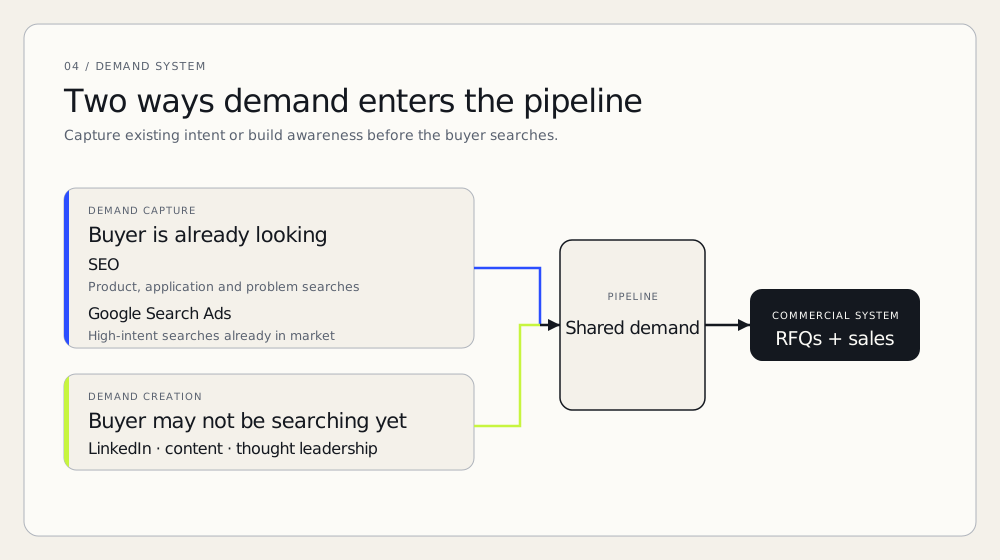
Google Search Ads and LinkedIn do different jobs, and neither works well when you expect it to do the other’s job.
Google Search Ads capture demand that already exists. Someone is actively searching for a product, a supplier, or a solution to a problem, and you’re paying to be the answer they see first. This works well for high-intent product searches, application searches, and location-based searches where a competitor’s ad might otherwise beat you to the click.
LinkedIn builds demand that doesn’t exist yet. You can target by industry, job function, and seniority, which makes it useful for reaching engineers or procurement leaders at companies who aren’t actively searching but should know you exist. It fits a new-market push or a longer sales cycle better than it fits generating an immediate RFQ.
| Channel | Primary job | Useful when | Limitation |
|---|---|---|---|
| Google Search Ads | Capture existing demand | The buyer already knows what they need and is actively searching | Doesn’t create new demand, and costs rise with competition |
| LinkedIn Ads | Build awareness with the right audience | You’re entering a new market, or the buyer doesn’t know you exist yet | Rarely produces an immediate RFQ, and short-term ROI is hard to measure |
| SEO | Capture and compound existing demand | Long-term visibility for product, application, and problem searches | Takes months to build momentum, and needs ongoing upkeep |
Neither channel is guaranteed to perform on its own. A Google Ads campaign with a weak landing page or a broad match strategy burns budget on unqualified clicks. A LinkedIn campaign with no clear offer or follow-up plan generates impressions and not much else. Performance depends on the combination of intent, targeting, the offer, the landing page, and whether you’re measuring the result, not on which platform you picked. If paid search or LinkedIn is part of your plan, Google Search Ads and LinkedIn Ads both need that groundwork in place before spend goes up, not after.
How do you connect marketing with sales?
Marketing and sales can stay disconnected in small manufacturing companies when no one has defined what counts as a qualified lead. Fix that first, and the rest of the connection gets simpler.
Start with a plain definition. A marketing-qualified lead might be someone who downloaded a technical resource or requested a datasheet. A sales-qualified lead is someone who submitted an RFQ with enough detail to quote. Those are different things, and treating every form fill as sales-ready wastes your sales team’s time.
For RFQ-driven businesses, qualification usually comes down to a short list: does the request include enough technical detail to quote, is the volume or project size worth pursuing, and does the timeline match your capacity. A simple intake form that asks for this up front saves a round of back-and-forth email before the real conversation starts.
Once a lead comes in, routing matters more than most small teams assume. If RFQs sit in a shared inbox for two days before anyone responds, buyers who are also asking your competitors for quotes have often already moved on. Even a basic rule, RFQs go to a named person within one business day, beats no rule at all.
A CRM, even a simple one, is worth the setup time here. It doesn’t need to be enterprise marketing automation. It needs to track where a lead came from, what happened to it, and whether it closed. Without that, you can’t tell which marketing activity is producing revenue.
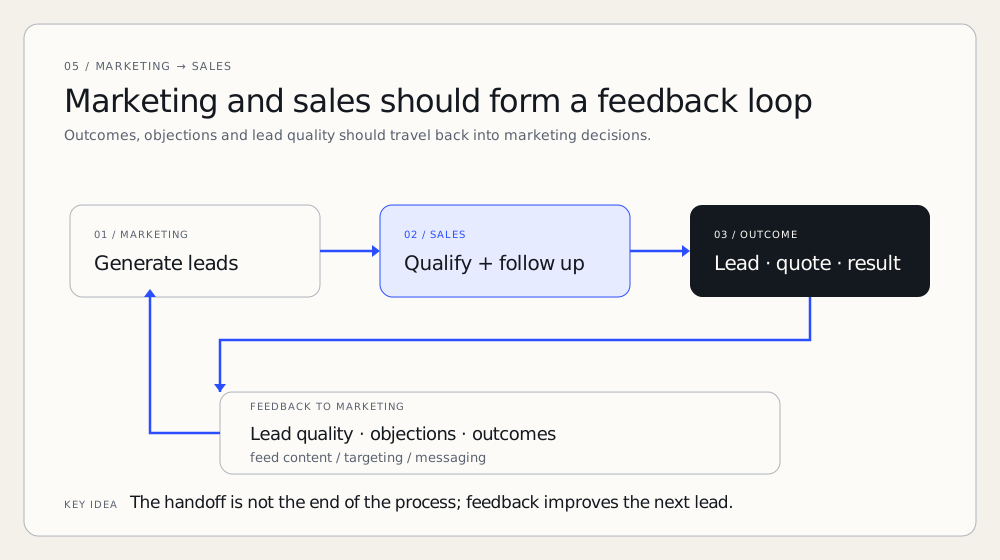
Feedback should flow back to marketing, not just forward to sales. If a lead comes in and gets disqualified, marketing should know why. If sales keeps hearing the same objection on calls, that’s a content gap marketing can close. If a distributor keeps forwarding leads that don’t match your ICP, that’s worth a conversation about what they’re telling prospects about you.
None of this requires enterprise marketing automation or a formal lead scoring model. For a team this size, a shared spreadsheet with clear fields and a habit of updating it consistently can provide a useful starting point without the setup cost of a complex system.
What should you measure?
Traffic and impressions aren’t enough on their own, because neither tells you whether marketing produced a real business result. You need metrics at several levels, and each one answers a different question.
| Metric level | What it tells you | Limitation |
|---|---|---|
| Visibility (impressions, rankings) | Whether you’re showing up for searches that matter | Doesn’t confirm whether visibility converts to interest |
| Engagement (page views, resource downloads) | Whether the right people are finding and reading your content | Doesn’t confirm buying intent by itself |
| Demand (RFQs, inquiries, demo requests) | Whether marketing is generating actual interest | Doesn’t confirm the lead is a good fit until sales reviews it |
| Pipeline (opportunities, source, win rate) | Whether marketing-sourced leads become real deals | Needs consistent CRM tracking to attribute correctly |
| Revenue (won deals, acquisition cost) | Whether the whole system is profitable | Long sales cycles delay this signal by months |
In a business with a long sales cycle, expect a real gap between marketing activity and the revenue number that eventually proves it worked. An RFQ submitted this month might not close for four to six months. That’s normal for this kind of sales process, not a sign the marketing failed, and it’s a reason to track the earlier-stage metrics rather than waiting on revenue alone.
Full attribution is also unrealistic here. A buyer might read a blog post in January, see a LinkedIn ad in March, and submit an RFQ in June after a colleague mentions your name at a conference. No tracking setup captures all of that cleanly. Track what you reasonably can, mainly RFQ source and pipeline value by channel, and treat anything more precise than that with some skepticism.
In what order should you build all this?
Building all of this at once is a common reason marketing efforts stall. The order matters, because each phase depends on the one before it working.
| Phase | Actions | Purpose |
|---|---|---|
| 1. Foundation | Define ICP and positioning, fix website structure, set up analytics and CRM, build conversion paths | Make sure the demand you already get can convert |
| 2. Demand capture | SEO, high-intent content, Google Search Ads, conversion optimization | Capture buyers who are already searching |
| 3. Demand creation | LinkedIn, thought leadership, case studies, technical content | Build awareness with buyers who aren’t searching yet |
| 4. Sales alignment | Lead routing, sales enablement content, CRM feedback, reporting | Make sure marketing leads turn into revenue |
| 5. Expansion | New markets, international SEO, account-based marketing, additional paid channels, automation | Scale what’s already proven to work |
Skipping to phase 3 while phase 1 is still broken is a common mistake. Building LinkedIn awareness for a website that can’t convert an interested visitor into an RFQ just moves the leak further upstream. Fix the foundation first, even when it feels slower than launching a visible campaign.
Not every company needs every phase right away. A company that’s already getting decent traffic but converting almost none of it should focus entirely on phase 1 before spending a dollar on paid demand generation. A company with a working RFQ process but no visibility for relevant searches should prioritize phase 2. Expansion, phase 5, only makes sense once the earlier phases are producing consistent results at home.
What’s your manufacturing marketing maturity level?
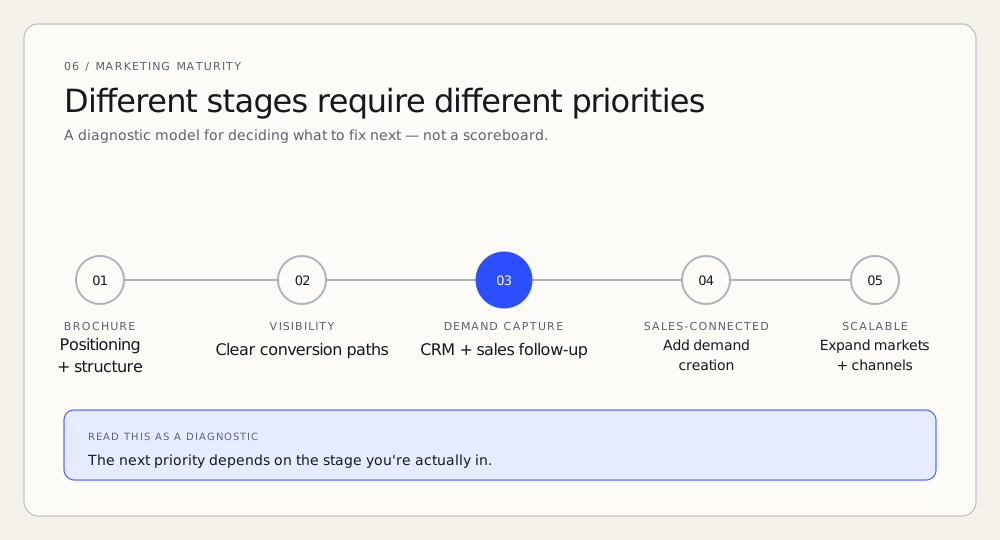
You can think of manufacturing marketing as five levels, and knowing which level you’re in helps you decide what to fix next instead of what to add next.
| Level | Characteristics | Next priority |
|---|---|---|
| 1. Brochure | Website mainly establishes credibility; RFQs come almost entirely from referrals, reps, and existing relationships | Fix positioning and basic website structure |
| 2. Visibility | SEO or content is starting to bring in relevant traffic | Build clear conversion paths so traffic turns into inquiries |
| 3. Demand capture | The website reliably converts traffic into RFQs | Connect leads to a CRM and a defined sales follow-up process |
| 4. Sales-connected | Marketing activity is tracked through to pipeline and revenue | Add demand-creation channels to grow reach beyond existing search demand |
| 5. Scalable | The company can expand to new products, markets, and channels with a repeatable process | International SEO, account-based marketing, additional paid channels |
This is a diagnostic, not a scoreboard. A company at level 1 isn’t behind in some competitive sense. It means the highest-leverage next step is fixing the website and positioning, not adding a paid ads budget on top of a site that can’t convert the traffic it already gets.
Where should a manufacturer start?
Start with the commercial decisions, not the tools. In practice, that means working through these in order.
- Define what you want marketing to produce, and for which products or markets.
- Identify the industries and applications worth prioritizing, based on margin and growth potential.
- Understand how your actual buyers search and what they need at each stage.
- Audit your current website against the traffic, evaluation, and conversion framework above.
- Fix the highest-impact conversion problems first, usually the RFQ path itself.
- Build the SEO and content foundation around how buyers actually search, not internal naming.
- Add paid search or LinkedIn once the foundation can convert what it brings in.
- Connect leads to a CRM and a clear sales follow-up process.
- Track RFQs, pipeline, and revenue by source, accepting that attribution won’t be perfect.
- Expand into new markets or channels only after the foundation is working reliably.
If your time is limited, steps 4 and 5 are a sensible place to start because they address the website and conversion path before you add more traffic. A website that already gets traffic but converts poorly is often a few fixes away from a meaningfully different result, and that’s true before you spend anything on new channels.
Frequently Asked Questions
What is B2B marketing for manufacturers?
It’s the set of marketing activities that help a manufacturing company get found by technical buyers, prove it can meet their requirements, and convert that interest into RFQs and eventually sales. It typically includes SEO, a website built for conversion, targeted content, and in some cases paid search or LinkedIn, all connected to the sales process.
Why is manufacturing marketing different from other B2B marketing?
The buying decision usually involves several stakeholders with different priorities, the sales cycle is long, and the purchase happens through a quote or tender rather than a simple checkout. Marketing built around a single generic buyer persona tends to miss most of the actual decision-making process.
What marketing channels work best for manufacturers?
It depends on what you’re trying to produce. SEO and Google Search Ads work well for capturing buyers who are already searching for a product or solution. LinkedIn works better for building awareness with buyers who don’t know you exist yet. For many manufacturers, getting SEO and website conversion right before adding paid channels provides a stronger foundation.
How do manufacturers generate more qualified RFQs?
Usually by fixing the website’s conversion paths before adding more traffic. A site with clear specifications, real case studies, and an obvious way to request a quote converts existing traffic better than a generic brochure site does, regardless of how much traffic it gets.
How important is SEO for manufacturers?
Very, because a large share of buyer research happens independently, before any conversation with a supplier. SEO makes sure your product and application pages show up for the specific searches your buyers are already running.
Should manufacturers invest in Google Search Ads?
It’s worth testing once your landing pages can convert a visitor into an RFQ. Search Ads work best for high-intent product and application searches. They’re a poor fit if the budget is small and the landing experience isn’t ready, since that combination burns spend on clicks that never convert.
Is LinkedIn worth it for manufacturing companies?
It can be, mainly for awareness and reaching specific job functions or industries rather than for immediate RFQs. It’s most useful when entering a new market or industry, or when supporting a longer sales cycle with content aimed at a specific buying committee.
How should manufacturers measure marketing ROI?
Track visibility, engagement, demand, pipeline, and revenue as separate layers, not one combined number. In a long sales cycle, expect a real delay between marketing activity and the revenue that eventually proves it worked, and use the earlier-stage metrics to judge progress in the meantime.
Should a manufacturer hire a marketing agency or build an internal team?
It depends on your team’s current bandwidth and skills. An in-house hire makes sense if you need daily coordination with sales and enough budget to justify a full-time role. A specialized agency or freelancer often fits better for a company that needs SEO, website, or paid search expertise without adding headcount, particularly while marketing needs are still being defined.
How long does manufacturing marketing take to produce results?
SEO and content typically take several months to build meaningful visibility, given how long it takes to earn authority and rankings for a set of terms. Paid search can produce clicks immediately, but qualified RFQs still take time to show up, especially with a sales cycle measured in months rather than weeks. Treat the first quarter as a build-out period, not a results period.
Start with one thing
If you take one action from this guide, audit your website against the traffic, evaluation, and conversion framework covered earlier. Find the biggest gap, usually a missing RFQ path, thin product pages, or unclear positioning, and fix that before adding a new channel on top of it.
Everything else here—SEO, paid search, LinkedIn, sales alignment—works better on a foundation that actually converts. Building on a weak foundation just moves more traffic into the same broken funnel.